How Much Does a Virtual Receptionist Cost in 2026? (Real Pricing Breakdown)
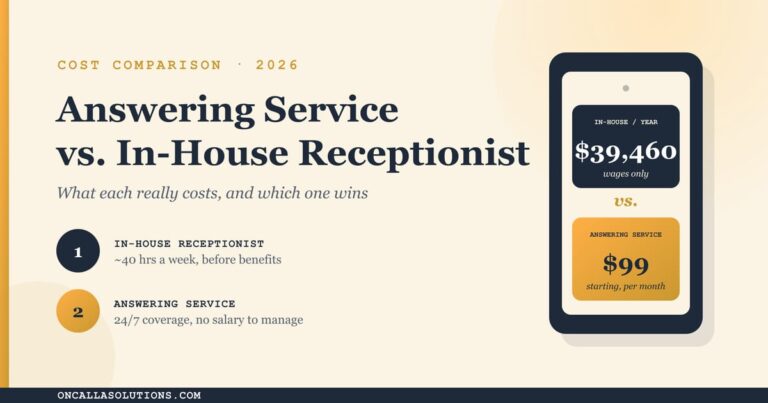
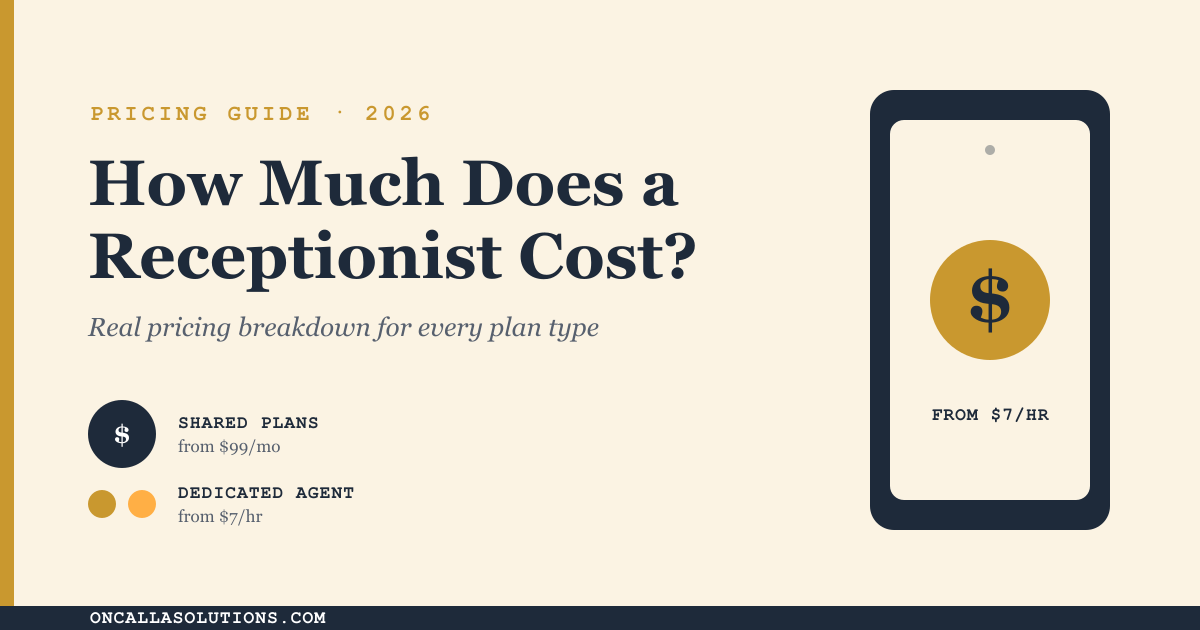
Virtual receptionist services typically fall into two pricing models: shared plans starting around $99–$150/month for a bundle of call minutes, or a dedicated agent billed hourly, usually $7–$20/hr depending on experience level and where the agent is based. Which one costs less depends entirely on your call volume and whether you want the same person answering every call or a rotating team.
What Actually Drives the Price
Four factors explain almost all the price variation you’ll see between providers:
1. Shared vs. dedicated agent. A shared plan pools your calls with other clients across a team of receptionists — cheaper per month, but you’re one of many accounts each agent juggles. A dedicated agent works exclusively on your account, which costs more per hour but means someone who actually knows your business answers every time.
2. Call volume / minutes included. Most shared plans are priced in minute tiers (e.g., 100, 300, 500 minutes/month) — go over, and you either pay overage or need to upgrade. A dedicated agent has no minute cap since you’re paying for their time, not per-call.
3. Live agent vs. AI vs. hybrid. Pure AI answering is generally the cheapest option since there’s no human labor cost, live agents cost more but handle nuance and judgment calls AI can’t, and hybrid models (AI first response with live-agent handoff) split the difference.
4. Add-ons. CRM integration, bilingual support, appointment scheduling, live chat, and analytics dashboards are often priced as add-ons on top of the base plan, not included by default.
Typical Industry Pricing Patterns
Across the virtual receptionist industry, you’ll generally see:
- Per-minute or per-call pricing, often with a monthly minimum
- Tiered monthly plans bundling a set number of minutes, with overage fees beyond that
- Hourly dedicated-agent pricing, usually scaling with the agent’s experience level
Whichever model you’re comparing, always check whether the base price includes a shared receptionist or a dedicated one — that single distinction explains more of the price gap between providers than almost anything else.
What OnCalla Actually Charges
To give a concrete reference point:
- Dedicated Agent — starting at $7/hr for 0–6 months of experience, scaling to $9/hr (1–2 years) and $12/hr (2–4 years) — a full-time, exclusive agent, not shared with other clients
- OnCalla 100 — $99/mo for 100 voice minutes, 24/7 answering, AI receptionist, local/toll-free number
- OnCalla 300 — $249/mo for 300 voice minutes, adds inbound/outbound sales and client intake
- OnCalla 500 — $399/mo for 500 voice minutes, adds CRM integration
See the full pricing and feature breakdown for details on every plan.
How to Pick the Right Plan for Your Call Volume
If you’re not sure how many minutes or hours you actually need, start with your real numbers: how many calls do you currently miss or field in a typical week? Our Missed Call Cost Calculator can help you estimate both your call volume and what missed calls are actually costing you — which makes it a lot easier to tell whether a shared minute-bundle plan or a dedicated agent makes more financial sense for your business.
Frequently Asked Questions
Is a virtual receptionist worth the cost?
For most small businesses, yes — the cost of a missed call (a lost customer who calls a competitor instead) is usually far higher than the cost of the service that would’ve answered it.
What’s the difference between a virtual receptionist and an answering service?
The terms are often used interchangeably. “Virtual receptionist” sometimes implies more receptionist-like duties (scheduling, routing calls, basic account management), while “answering service” can mean simpler message-taking — but in practice, most providers (including OnCalla) offer both under one plan.
Can a virtual receptionist handle appointment scheduling?
Yes — this is a standard feature across most plans, including all of OnCalla’s, not typically an extra add-on.
Do virtual receptionists work for small businesses, or just enterprises?
Small businesses are actually the primary market — most providers, OnCalla included, are built around per-minute or hourly pricing specifically so a business with modest call volume isn’t stuck paying enterprise-scale rates.