Answering Service vs. In-House Receptionist: Cost, Coverage, and Which Wins (2026)
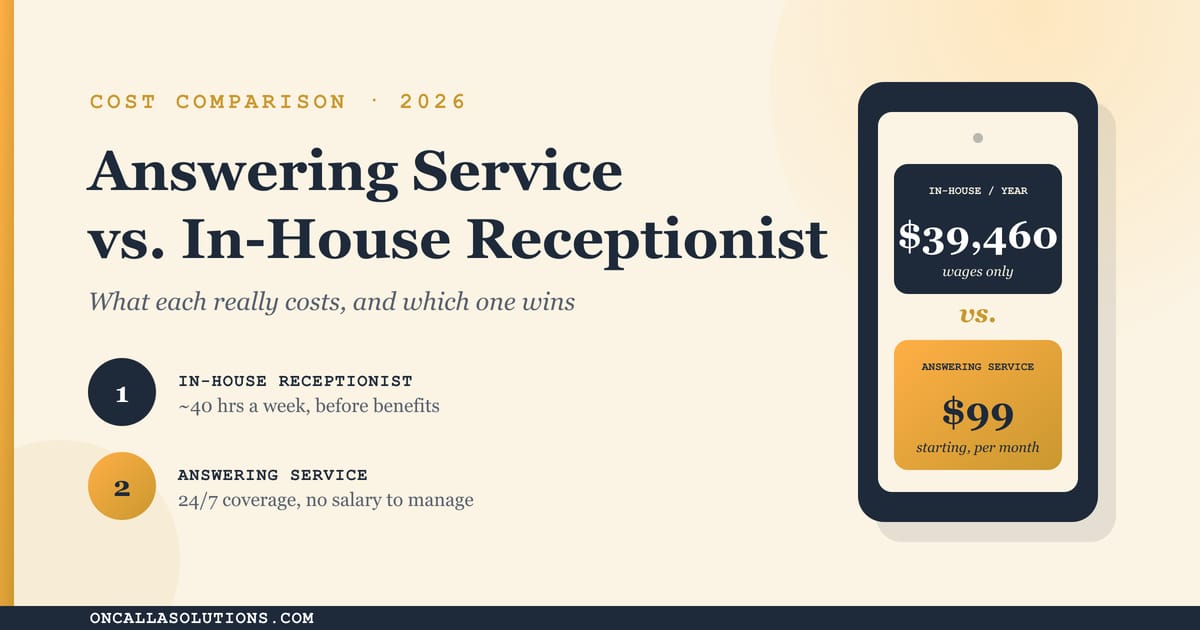
Hiring an in-house receptionist costs about $39,460 a year in wages alone for a full-time employee (the U.S. average, per the Bureau of Labor Statistics), before payroll taxes, benefits, training, or the cost of covering sick days and vacations. An answering service covers the same phones starting at $99 a month, or from $7 an hour for a dedicated agent. The right choice depends on what your business actually needs done, and this guide walks through the real numbers so you can decide.
The Short Answer
- Choose an in-house receptionist if you need someone physically present — greeting clients, handling packages, managing a waiting room — and your call volume is steady during business hours.
- Choose an answering service if your main problem is missed calls, after-hours coverage, or unpredictable call volume, and you want to pay for coverage rather than a salary.
- Use both if you have a front desk but need overflow, lunch, after-hours, and weekend coverage. This is common, and usually the cheapest way to never miss a call.
What an In-House Receptionist Really Costs
The salary is the smallest part of the picture. According to the BLS Occupational Employment and Wage Statistics (May 2025), the average receptionist or information clerk in the United States earns $18.97 per hour, or $39,460 per year, and about 910,000 people work in the role. From there, the costs stack up:
- Employer payroll taxes. Employers pay 7.65% of wages toward Social Security and Medicare. On $39,460 that is roughly $3,019, bringing the total to about $42,479 before any benefits.
- Benefits and paid time off. Health coverage, retirement contributions, and paid leave add to the real cost, and vary widely by employer.
- Recruiting and training. Advertising, interviewing, onboarding, and the weeks before a new hire is fully productive.
- Turnover. When a receptionist leaves, you pay for the gap and start the hiring cycle again.
- Coverage gaps. Sick days, vacations, lunch breaks, and holidays leave the phones unattended unless someone fills in.
The Coverage Problem Most Cost Comparisons Skip
One full-time employee works about 40 hours a week. A week has 168 hours. That means a single receptionist covers under a quarter of the hours your customers might call.
To answer phones around the clock with in-house staff you would need roughly 4.2 full-time employees. At the national average wage, that is about $165,700 a year in wages before shift differentials, payroll taxes, or benefits. Even a business that only wants evenings and weekends covered is hiring multiple people for partial shifts.
Answering Service vs. In-House Receptionist: Cost Side by Side
| Option | Hours covered | Approximate annual cost |
|---|---|---|
| One in-house receptionist (national average wage) | ~40 hrs/week | $39,460 wages, ~$42,479 with employer payroll tax, before benefits |
| In-house staff for 24/7 coverage | 168 hrs/week | ~$165,700 in wages alone (about 4.2 employees) |
| OnCalla dedicated agent, starting rate ($7/hr) | 40 hrs/week | ~$14,560 |
| OnCalla dedicated agent, starting rate ($7/hr) | 168 hrs/week | ~$61,150 |
| OnCalla 100 / 300 / 500 shared plans | 24/7 | $1,188 / $2,988 / $4,788 per year ($99 / $249 / $399 per month) |
In-house figures use BLS national averages and are wages plus, where noted, employer payroll tax only; they do not include benefits, recruiting, or training. Answering service figures are starting rates; your actual cost depends on the plan and call volume. See the pricing page for current plans.
Receptionist Wages Vary a Lot by State
The national average hides a wide range. In May 2025 the BLS reported average annual receptionist wages of about $50,450 in Washington, D.C., $46,100 in California, $45,690 in Washington State, and $44,840 in New York — compared with $32,160 in Mississippi, $32,560 in Alabama, and $32,800 in Louisiana. The gap between California and Mississippi alone is nearly $14,000 a year per employee.
Because an answering service is priced by coverage rather than local wages, the savings tend to be largest in high-wage states. You can see the average receptionist wage for your state on our location pages, for example California, New York, Texas, and Florida.
What Each Option Does Better
Where an in-house receptionist wins
- Greeting walk-in clients and visitors in person
- Handling mail, deliveries, scheduling rooms, and other on-site tasks
- Deep, day-to-day knowledge of your team and clients
- Consistent presence during standard business hours
Where an answering service wins
- Nights, weekends, holidays, and overflow when your team is busy or out
- Predictable cost with no benefits, sick days, or turnover to manage
- Scaling up or down as call volume changes, without hiring or laying off
- Getting started in days rather than weeks of recruiting and training
Which One Fits Your Business?
- Home services, contractors, and emergency trades: customers call at all hours and often call the next company if no one answers. An answering service usually fits better than a single receptionist.
- Medical, dental, and legal offices: many use both — a front-desk employee during office hours and an answering service for after-hours and overflow. Recording and consent rules apply on calls, so review our state-by-state guide to call recording consent.
- Small offices with low call volume: paying a full salary for a few calls a day is rarely efficient, and a shared plan may cost a fraction of that.
- Businesses with heavy walk-in traffic: you need a person on site, so keep the in-house role and add an answering service for the phones when it gets busy.
Estimate What Missed Calls Cost You
Before deciding, put a number on the problem. Our free missed call cost calculator estimates monthly and yearly revenue lost to unanswered calls using your own figures. If that number is bigger than the cost of coverage, the decision is usually straightforward. For a broader checklist on evaluating providers, see how to choose an answering service, and for pricing detail across plan types, read our virtual receptionist cost breakdown.
Frequently Asked Questions
Is an answering service cheaper than a receptionist?
For phone coverage, almost always. A full-time in-house receptionist averages about $39,460 a year in wages before taxes and benefits, and covers roughly 40 hours a week. Shared answering service plans start at $99 a month and cover calls around the clock. The comparison changes only if you need someone physically present.
Can an answering service replace a receptionist completely?
For calls, yes — answering, taking messages, qualifying leads, and booking appointments. It cannot greet visitors, sign for packages, or handle other in-person tasks. Many businesses keep a front-desk person for those duties and use an answering service for everything else.
How many receptionists do I need for 24/7 phone coverage?
About 4.2 full-time employees, since a week has 168 hours and one employee works about 40. That is before covering sick days, vacations, and holidays.
What does a receptionist really cost beyond salary?
Employers pay 7.65% in payroll taxes on top of wages, plus benefits, paid time off, recruiting, training, and the cost of turnover. Our figures above include only the payroll tax, so your real cost will be higher.
Can I use both an answering service and an in-house receptionist?
Yes, and it is a common setup. The receptionist handles in-person work and daytime calls, while the answering service picks up overflow, lunch breaks, after-hours, and weekends, so no call goes to voicemail.
Wage figures are from the U.S. Bureau of Labor Statistics, Occupational Employment and Wage Statistics, May 2025 estimates for Receptionists and Information Clerks (SOC 43-4171), available at bls.gov/oes. Employer payroll tax rate reflects the combined Social Security and Medicare employer contribution. Your costs will vary by location, benefits, and provider.