How to Choose an Answering Service for Your Business
Choosing an answering service comes down to five things: coverage hours, industry experience, call-handling flexibility (scripts, transfers, appointment booking), pricing structure, and how easy it is to test before committing. Get those five right and the rest — scripts, integrations, tone — can be adjusted after launch.
The stakes are higher than they look. A missed call isn’t just a missed conversation — it’s a lead who called your competitor next, a customer who assumed you were closed for good, or an emergency that went unanswered. Most businesses that shop for an answering service have already felt that cost once. This guide walks through exactly what to evaluate so you don’t end up switching providers again in six months.
1. Coverage: Do You Need 24/7, or Just Overflow?
Not every business needs round-the-clock coverage. Some only need calls answered after hours or when staff is on another line (overflow). Others — especially in home services, healthcare, and legal — genuinely lose business every time a call goes to voicemail, day or night. Before comparing providers, decide which of these you actually are:
- 24/7/365 — emergencies, healthcare, legal intake, home services (plumbing, HVAC, locksmiths)
- Business hours only — professional services, retail, most B2B companies
- Overflow/after-hours only — businesses with in-house staff who just need backup
This alone eliminates providers whose plans don’t match — some only offer business-hours coverage, others require a 24/7 contract even if you only need occasional overflow.
2. Industry Experience Matters More Than It Seems
A generic answering service can take a message. An experienced one knows how to triage a call. A receptionist trained on legal intake knows not to give legal advice; one trained for HVAC knows to ask about the make/model of a unit before booking a truck roll; one trained for medical offices understands HIPAA-safe call handling. Ask any provider you’re evaluating directly: “Do you have experience in my industry, and can I see how those scripts are handled?”
3. Call-Handling Flexibility
Not all answering services do the same job. Some only take messages. Others can transfer calls live, book appointments directly into your calendar, qualify leads against criteria you set, and follow custom scripts per call type. Match the service’s actual capabilities to what you need done on the call, not just whether the phone gets answered:
- Message-taking only — cheapest, but the caller still has to wait for a callback
- Live transfer — connects urgent calls to you or your team in real time
- Appointment scheduling — books directly into your calendar system
- Lead qualification — screens callers against your criteria before you spend time on them
4. Understand the Pricing Model Before You Compare Providers
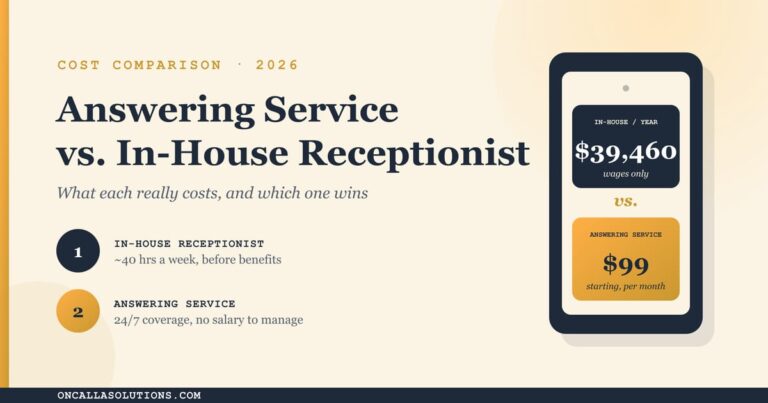
Answering services generally price one of two ways: per-minute/per-call plans, or dedicated agent hourly plans. Per-minute plans scale with your call volume and are usually cheaper for lower volume; dedicated agent plans give you a consistent person or small team and tend to make sense once volume is high enough to justify it. See our full pricing breakdown for how these compare directly, and use our missed call cost calculator to estimate what unanswered calls are actually costing you before you set a budget.
5. Test Before You Commit
Most reputable answering services offer a trial period or month-to-month terms rather than locking you into a long contract upfront. Use it. Call in yourself, pretend to be a customer with an odd question, and see how the agent actually handles it. A provider that won’t let you test before signing a long-term contract is a red flag.
Per-Minute vs. Dedicated Agent: A Side-by-Side Look
| Per-Minute / Shared Plan | Dedicated Agent | |
|---|---|---|
| Best for | Lower or variable call volume | Consistent, higher call volume |
| Who answers | Rotating pool of trained agents | Same person or small dedicated team |
| Typical starting price | From $99/mo | From $7/hr |
| Consistency | Scripts kept consistent, but agent varies call to call | Higher familiarity with your business over time |
| Scales with volume? | Yes, automatically | Requires adding hours or agents |
Neither model is objectively better — it depends on your call volume and how much continuity matters for your business. A law office fielding a handful of calls a day may prefer a dedicated agent who learns their intake process; a seasonal retailer with unpredictable volume may prefer a per-minute plan that flexes with demand.
Questions to Ask Before You Sign
- What happens during a call volume spike — are overflow calls answered, or do they roll to voicemail?
- How are agents trained, and how often do they handle businesses like mine?
- Can I review call recordings or transcripts to check quality?
- What’s the actual process to change my script or call-handling rules after launch?
- What’s the cancellation policy if the service doesn’t work out?
- Is pricing per-minute, per-call, or per-hour — and what happens if I go over?
Red Flags to Watch For
- Long-term contracts with no trial period. Confident providers let you test the service before locking you in.
- Vague pricing. If a provider won’t give you a straight answer on per-minute overage costs or hidden setup fees, expect a surprise bill later.
- No way to hear sample calls or check reviews specific to your industry. A generic sales pitch isn’t proof of call quality.
- Scripts you can’t edit. Your business changes; if updating a script requires a support ticket and a week’s wait, that’s a problem.
Quick Checklist
- Coverage hours match your actual call pattern
- Experience in your specific industry, not just “general business”
- Call-handling capabilities match what you need done, not just “answered”
- Pricing model fits your call volume — per-minute vs. dedicated agent
- Trial period or month-to-month terms available
- Recording consent handled correctly if calls are recorded — see our guide to consent laws by state
Frequently Asked Questions
How much does a good answering service cost?
Plans typically start around $99/month for shared/per-minute coverage, with dedicated agent plans starting around $7/hour. See our full cost breakdown for exact pricing by plan type.
What’s the difference between an answering service and a virtual receptionist?
The terms are often used interchangeably. In general, “answering service” leans toward message-taking and call routing, while “virtual receptionist” implies a fuller front-desk experience — appointment booking, live transfers, and a more personalized greeting — but the exact capabilities depend entirely on the specific plan, not the label.
Can an answering service handle both inbound and outbound calls?
Most are built primarily for inbound calls, though some providers offer blended plans that include outbound follow-up and reminder calls. See our inbound vs. outbound guide for how to tell which you need.
Do I need a long-term contract?
No reputable provider should require one upfront. Look for month-to-month terms or a trial period so you can test call quality before committing long-term.
How long does it take to get an answering service set up?
Most providers can have a basic script and call routing live within a few business days. More complex setups — custom appointment booking, CRM integration, multiple call types — can take one to two weeks to fully dial in.
Still weighing the decision? Compare our plans and pricing directly, or run your numbers through the missed call cost calculator to see what unanswered calls are costing you right now.